Surface tension
Surface tension in terms of “Energy”
In a liquid, intermolecular attraction is stronger than thermal motion, allowing molecules to remain bound together. If thermal motion were dominant over these attractive forces, the substance would exist in the gaseous phase. Within the bulk liquid, molecular interactions are isotropic, so each molecule experiences balanced forces from its surroundings, giving rise to zero net force. In contrast, molecules located at an interface lose roughly half of their cohesive interactions, as illustrated in Fig. 1. To reduce the energetic penalty associated with this imbalance, the liquid surface deforms to minimize its area, which gives rise to surface tension.
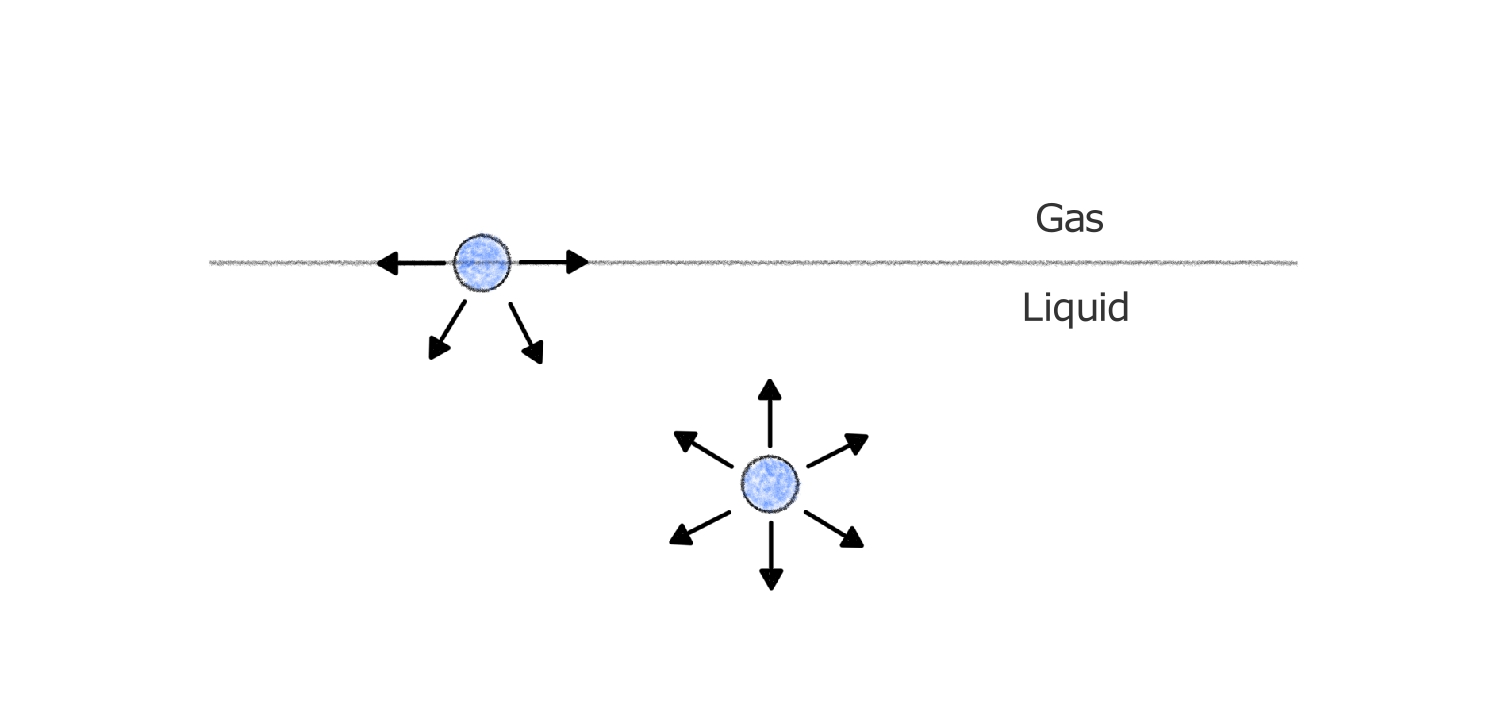
When a liquid molecule is positioned at the surface, it experiences an unfavorable energy state. Within the liquid, if the cohesion energy per molecule is $U$, a molecule at the surface lacks approximately half of this energy, or $U/2$. Given that the typical molecular size is $a$, the energy per molecular area is written as $E_m=U/2a^2$. The total energy, $E_s$, over the whole surface area, $S$, is called “surface energy” and is simply $E_s = S E_m = S~U/2a^2$. Here, the coefficient of the surface area is what we call “surface tension”, which is $\gamma=U/2a^2$.
In my favorite book, Capillarity and Wetting Phenomena [1], the authors estimated the surface tensions of different liquids very simply. For most oils, where van der Waals forces dominate, $U$ is roughly equal to the thermal energy $kT$. At $25^\circ \mathrm{C}$, $kT$ is approximately $1/40~\mathrm{eV}$, resulting in a surface tension $\gamma$ of about $20~\mathrm{mJ/m^2}$. Water, due to its hydrogen bonding, has a higher surface tension of approximately $72~\mathrm{mJ/m^2}$. Mercury, a liquid metal with strong cohesive forces and U around $1~\mathrm{eV}$, has a surface tension close to $500~\mathrm{mJ/m^2}$.
Surface tension in terms of “Force”
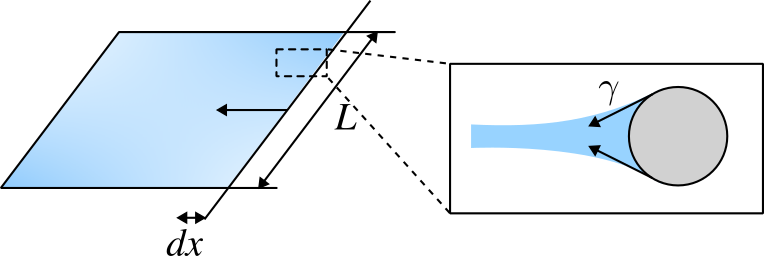
Surface tension, $\gamma$, can also be expressed as force per unit length [$\mathrm{N/m}$]. Consider a soap film stretched across a rectangular frame, with a movable rod placed on the right side of the frame, as illustrated in Fig. 2. In this configuration, if the rod is unconstrained, the surface tension force pulls it inward to minimize the surface area.
Let’s watch this padagogical lecture by David Quéré from ESPCI-PSL University.
The lecturer explains that the change in the surface energy transfers to the work of moving a rod, expressed as:
\[-dE_s = F dx = 2 \gamma L dx,\] \[\therefore F = 2 \gamma L.\]Indeed, surface tension can be written in terms of force.
References
[1] Gennes, P. G., Brochard-Wyart, F., & Quéré, D. (2004). Capillarity and wetting phenomena: drops, bubbles, pearls, waves (pp. 7-9). Springer New York.
Enjoy Reading This Article?
Here are some more articles you might like to read next: